Custom Search
Showing posts with label Embroidery. Show all posts

Wednesday, 14 May 2008

Wonderful and easy Bullion Knots Technique To Follow...

One of the most challenging for embroidery hand is to do a bullion knots. Maybe some of you will say it is easy and simple to do.Just wrap the thread, then you get the result. Are they produce very well and beautiful finised result? So, you have your answer..*wink*

I saw several videos on bullion knots lately since this technique is suitable if we want to put at our tudung (hijab) as accessories. For your information, to buy a tudung with beautiful embroidered in KL is very expensive. It will cost you RM100-200..Do you capable to buy?? For me, I dont think so..

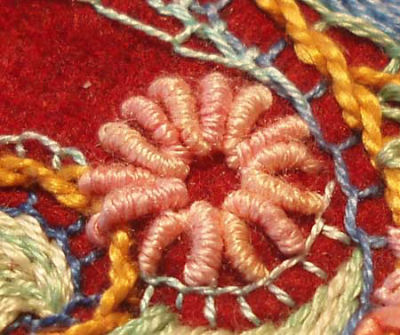
Today, I think i would like to share my favourite video of the bullion knots technique. I love all Mary Corbet's video tutorial actually. It is easy to follow and the techniques make the finished result so wonderful. So here, it is a bullion knots from Mary Corbet tutorial video. Hopefully, it will give you more inspiration and it will help you to have wonderful and beautiful roses ,daisies and other bullion finished result!

Enjoy....


Tips before you starting to do the bullion knots.


1. The needle you use is important. Yor work will be easy with a milliner (or straw) needle. The difference between milliner needles and other needles is that the entire shaft of the needle is the same diameter, so the eye doesn't bulge. This makes it easier to pull the needle through the wraps in the thread.

2. When you wrap your threads around the needle, you want them to follow the natural twist of the thread. So, for most stranded cottons and everyday threads, you're going to wrap your thread clockwise around the needle. The way to tell if you're going in the right direction is this: if, as you wrap your thread around the needle, the strands of thread start to untwist and separate, you're going in the wrong direction.

3. If you're having trouble getting the needle through th wraps, you can roll your thumb over the wraps lightly, back and forth, which will loosen them. Another trick is to roll your needle between your finger and thumb, back and forth in small movements, before you pull your thread through.

Wonderful bullion knots by Mary Corbet

]


( Resources : Mary Corbet tips, video and techniques )

Friday, 2 May 2008

Amazing Di Van Niekerk's needlework

Di van Niekerk is one of the most popular embroiderer which author of several books of needlecrafts ( ribbon embroidery, stumpwork ) and she is living in cape town. Her design was so beautiful and her design may inspire all of us.
Her latest 3 titles, Ribbon Embroidery and Stumpwork, Dreamscapes in Ribbon Embroidery and Stumpwork and A Perfect World in Ribbon Embroidery and Stumpwork have been translated into several languages and these international bestsellers also can be found at Bazaar Perantau Book Store

For who interested to learn the embroidery techniques, you can find her online video at Di Van Niekerk's Video. For full version of the video, you have to purchase their DVD at Di Van Niekerk's DVD

Here, is one of the Di Van Niekerks video on how to do twirled ribbon rose. Look simple, but need more practice for fine result!

Enjoy watching!


Twirled Ribbon Rose Technique

Tuesday, 29 April 2008

About Ribbon Embroidery

How To Do Ribbon Embroidery
by Alex Sysoef

Ribbon embroidery is a type of embroidery that combines the use of ribbon embroidery floss and perle cotton to create beautiful, delicate handwork. It is fairly easy to do and even a beginning embroiderer can use some simple stitches to create very nice patterns. So you may wonder what to look for when you search for instructions on how to do ribbon embroidery.

One of the most important things to consider when trying to learn how to do ribbon embroidery, also commonly called silk ribbon embroidery, is that your best sources will be ones that provide visual aids. You want to look for books, which include clear illustrations. Many craft websites offer still pictures or videos of sample projects being done. These visual helps can make the difference in doing a project correctly.

The first step to take when you want to find instructions on how to do ribbon embroidery is to decide on the type of design you would like to do. You might try purchasing a pattern book from a local or online bookstore. Many local libraries also have craft books that you can borrow. Another option is to look at some of the many places on the Internet that provide patterns and step-by-step visual instructions. There are many free patterns that you can try or you can go ahead and purchase something that looks good to you. You can find many forums and discussion groups composed of fellow embroiderers who are happy to share their patterns.

Another option to consider when trying to learn ribbon embroidery is to find a class that is being offered in your area. It is always easier to learn something like this by watching another person do it. Or if you have a friend or relative who does ribbon embroidery, ask them if they will demonstrate some of the stitches for you and then help you with your first project.

Once you find a pattern that you want to try, you will need to purchase the required supplies. Most patterns give a very specific list and you should follow their exact recommendations as much as possible. Here are some common supplies that you will need for any project:

1. An embroidery needle. Make sure the eye is large enough for ribbon to pass through. Many people recommend Chenille needles as being the best choice for ribbon embroidery as they have a large eye and a sharp tip. These needles come in different sizes so follow the recommendations for your specific pattern.

2. Silk embroidery ribbon in the colors you have selected for your design.

3. An embroidery hoop.

4. The fabric you have chosen to put your design on.

There are many different stitches that can be used alone or in combination to create various motifs or stitch patterns. The ribbon stitch is used for ribbon only. Some other basic stitches that you may need to use are lazy daisy, stem stitch, straight stitch and French knots. These stitches are also used with regular embroidery thread.

Needlework is a relaxing and enjoyable hobby for many people. By finding and learning instructions on how to do ribbon embroidery, you can create many lovely pieces to pass on to friends and family.

Friday, 25 April 2008

Embroiderer Blogs

Today, I would like to share and happily added the link of Sharon Baggon's (Sharon B) blog and Mary Corbet Website. Sharon B's blog (In A minute a go) and Mary Corbet ( Needle's N Thread) are my favorite blog and reference which is I hope it will inspire the embroiderers and as a good knowledge for a beginner. Mary Corbet is very kind to show us her private video for most of the stitches techniques. Very clear video instruction. It is good for beginner.

I also added one of my favorite embroiderer, Umi. I love her embroidery work and design. The design and her embroidery handwork very nice and beautiful. You can see her handwork at Embroidered Gift

If you have great website, resources and blog for stitches, embroidery and good free pattern/design to share, email me at mylina_crafts[at].yahoo.com. Thank you.

Other Resources and Links

Add to Technorati Favorites